HERSILL | NEWS | CSR | LOCAL SOCIAL ACTION |
There are different areas in which Hersill collaborates to improve patient care and quality of life. One of them is the Saniclown Project (National Nonprofit Hospital Clown Association), an initiative that puts spirit medicine into practice, using one of the most legendary antidotes: joy.
This project, which has 10 years of experience, allows to relieve those difficult moments, sometimes long, in the time, which means to be hospitalized, especially for the younger ones who see this alien, unfamiliar and welcoming space, isolating themselves from social life.
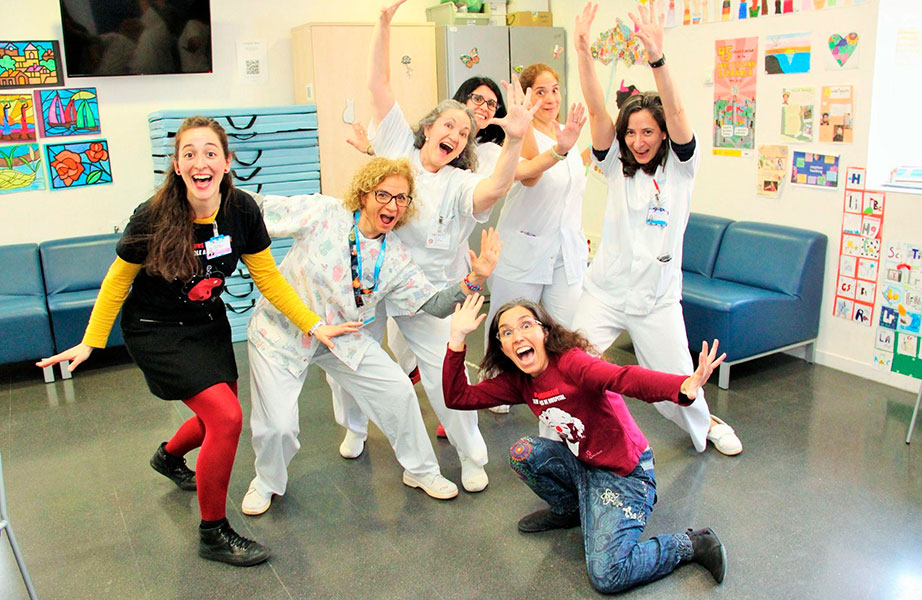
It consists of workshops of theatrical improvisation and clowning, says Maria Castro, project manager of the entity, “with the idea of breaking the hospital routine, collaborating with the release of the tension of young people and contributing to their emotional management.”
In 2025, according to Saniclown project manager María Castro, the organisation has managed to consolidate its collaboration in different hospital areas. Saniclown has highlighted the experienced team it has formed this year, with a great ability to adapt to the needs of patients in such delicate situations as oncology, paediatric palliative care and adolescent psychiatry. In addition, the joint work with healthcare personnel in paediatric palliative care home visits has been particularly significant. As María explains, “the clown becomes an essential part of the team, providing care, well-being and joy, completely changing the perception of the patient and the family”, which has been recognised with an award from Madrid City Council in 2025.
Thanks to the collaboration of Hersill, Saniclown has held ongoing workshops at the Niño Jesús Hospital, reaching more than 300 adolescents in the Psychiatry Unit. These workshops, held three times a month, have had a major impact on the emotional well-being of patients, helping them to release tension, socialise in a safe environment and strengthen their commitment to treatment. This work is particularly relevant, says María Castro, in the context of a 47% increase in hospitalisations for mental health disorders in children under 18 in the last decade, according to data from the Ministry of Health.
The initiative, which began with workshops for adolescents in the area of psychiatry of the Hospital Gregorio Maranon, covers all ages, carrying out, in addition to activities in the hospital field, accompanying the health staff of the Hospital Nino Jesus, in home interventions to children with palliative care so that the experience, in the words of Maria, “comes with play and affection.”
There are many benefits that it brings since, not only benefits patients, but also families, health care personnel and the professionals who perform them.
Among the main improvements are a greater adaptation and subjective experience to the hospital context, an improvement in behaviour by encouraging meaningful learning and an increase in cognitive flexibility thanks to the connection that is given with other constructive parts of themselves. This creates a sense of well-being, peace and reconciliation, and helps them to accompany and sustain their own recovery process, developing skills that benefit socialization and channelling their problems through humour.
And it is that all this, says Maria Castro, “contributes to their emotional well-being and greater adherence to the treatment they are experiencing, which has a very positive impact on families and friends.” For Marta Soriano, occupational therapist at San Carlos Hospital, “it is a group activity, where aspects such as: body awareness, communication and expressiveness, socialization, creativity and imagination are worked. They are components that in this population it is important to stimulate.”
The improvement of the emotional balance brought by the participation of patients in Saniclown’s workshops also involves developing the patient-health professional bond since, points out Maria, by participating in a different context, they see the professional from another perspective, so it becomes an activity of great value and of great use for therapists.
Also, Marta Soriano emphasizes that “it is another way to see how they develop with other professionals and allows to make an assessment of both their behavior and the responses they have to the proposed activities. In addition, they are very good professionals in their field and understand and adapt to the characteristics of this population, knowing how to handle the situations that occur at any given moment.”
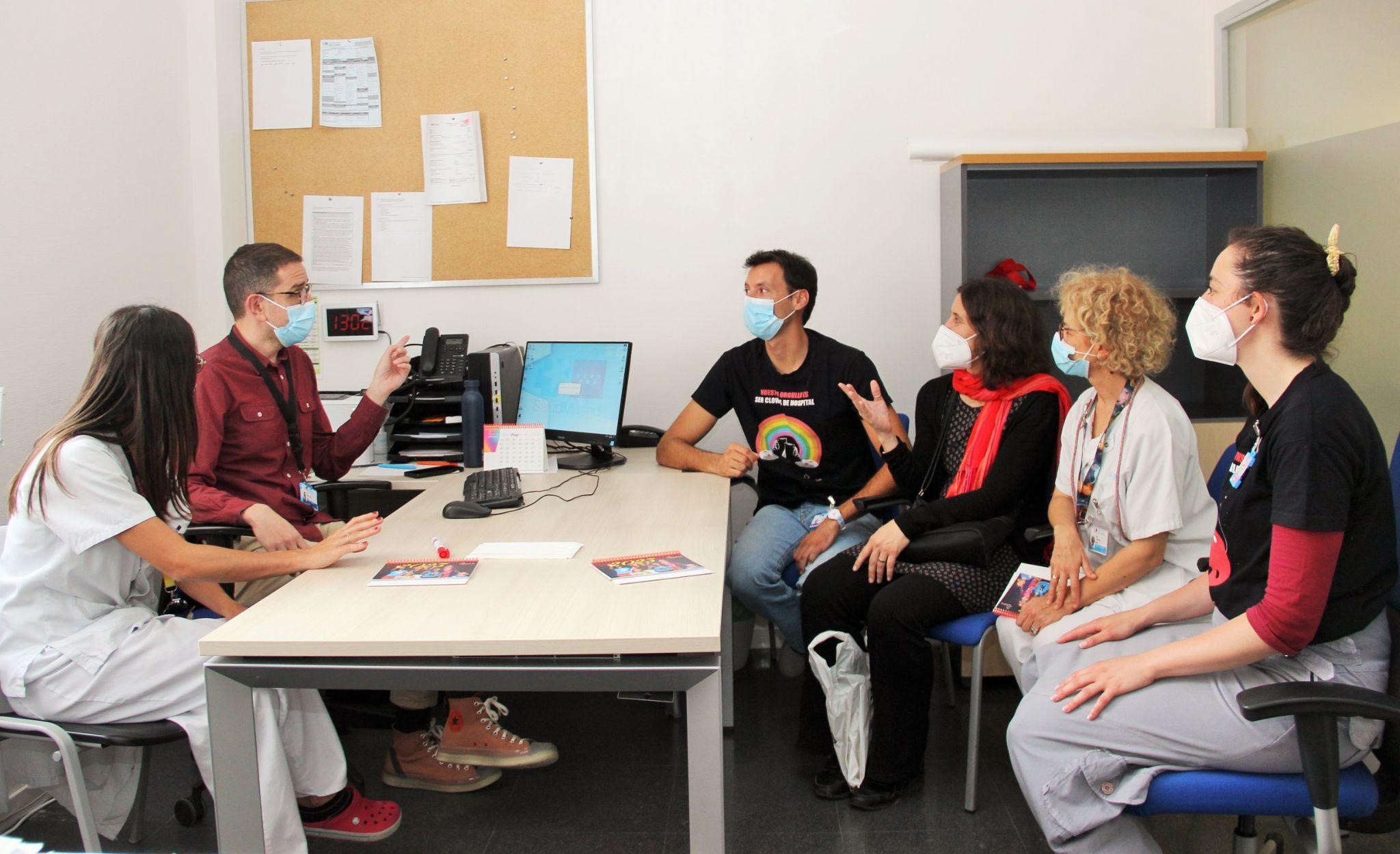 Saniclown meeting with a group of professionals from the Adolescent Hospitalization Unit, San Carlos Clinical Hospital, Institute of Psychiatry and Mental Health
According to the Life study carried out by the Pallapupas Association, the work of this type of actions in hospitals improves by 43% percent the mood of pediatric patients, declaring 79% that they feel much happier. For families, the impact of waiting on the process is reduced by 92%, improving by 19% the way they deal with the passage of their child’s operating room. In adult cancer patients, anxiety is reduced by 39% and states of rage and anger are reduced by 40%. In professionals both in children and in adults a better patient-health ratio is generated, in children up to 80% and in adults well-being increases up to 70%.
For the implementation of the workshops there is a team of two people: a performing arts teacher specialized in improvisation and clown, who is responsible for coordinating the activity and bringing the dynamics of the activity, and a hospital clown who acts as another participant, being a figure who is not afraid of ridicule or error, as a way to help the participation of the other participants.
The support of the hospital and the health professionals with whom Saniclown works together is essential to successfully carry out this project. In addition, the collaboration of sponsors to support these projects is essential.
Hersill’s commitment, says Maria, “has allowed us to take a safe step” to establish a workshop in a new hospital where SaniClown had not previously worked, the Hospital Clinico San Carlos. “Hersill is a company that had collaborated with us on more generalist projects, and when we presented it with this new project, it did not hesitate to join,” he explains.
In 2025, Saniclown is working in three hospitals: Gregorio Marañón Hospital (in the adolescent psychiatric ward and in PRISMA with adolescents receiving outpatient intensive care); San Carlos Clinical Hospital (with adolescents and adults in the psychiatric ward); and Niño Jesús Hospital, also in the adolescent psychiatric ward.
In addition, Saniclown has other interventions such as hospital clowns at the Infanta Leonor Hospital, where they work in paediatrics, accompanying endoscopies and the dialysis unit.
Saniclown also carries out awareness-raising activities throughout the year in schools and at events, notably its Saniclown Gala at the Teatro Circo Price in Madrid, which this year was held on 10 and 11 October.
+info:
Visit the Saniclown website