
Music therapy for older adults is establishing itself as a supportive tool that helps to connect with the individual, promote wellbeing and foster a more humane approach to care in cases of cognitive decline, both in the early stages and in more advanced cases.
Music that restores a person: when care also involves listening
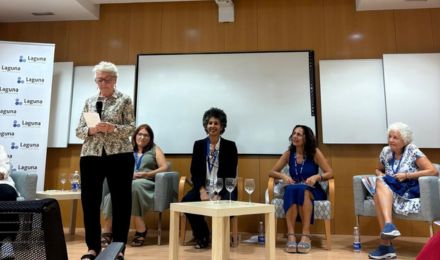
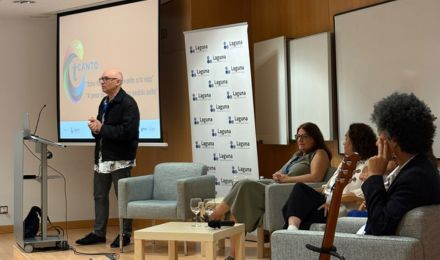
From the outset, the Conference on Music Therapy for Older Adults, held at the Laguna Care Hospital – Vianorte Foundation in collaboration with Hersill, was an event designed to bring together carers, healthcare staff, music therapists and family members. It was a forum created to reflect on new ways of supporting older people.
The event was based on a clear idea: that music does not seek to replace treatments or promise what it cannot deliver, but rather to create spaces for connection, expression and wellbeing. A cosy room, a stage with six chairs on it, and many stories to tell. As Cora Levinson, a qualified music therapist and author and co-author of publications on music therapy practice, explained, “music does not restore memory, but it can restore the person”.
Music therapy and active ageing: reconnecting with oneself
According to the World Federation of Music Therapy, music therapy is a professional discipline that uses music-based experiences – such as listening, singing or playing instruments – to promote health, wellbeing, abilities and development in personal and social spheres. In this context, music therapy for older adults forms part of an approach to active ageing that focuses on the individual rather than solely on the illness.
During the event, participants shared experiences of patients with advanced cognitive impairment who, through music, were able to display emotional responses or make small movements in time with a melody. People who could barely remember their own names were able to reconnect with who they were through just a few melodies. Music becomes a channel of communication when other forms of language begin to prove more difficult.
Nieves Frencilla, a music therapist and social educator, explained her method. Her therapy does not simply involve playing a playlist. It is a form of care. It is all based on a very pure idea. “Music does not require you to remember, it does not require you to speak, nor does it require you to understand. It simply asks you to feel.” Sometimes words are no longer enough. Life becomes chaotic due to the onset of dementia. At such times, a steady rhythm becomes a safe haven to lean on.
Her ultimate aim is not to recover what has been lost. She seeks to accompany with dignity that which still beats within, and strives to make music a tool tailored to each individual.
A personalised approach that supports the patient and their family
Every patient has a story, memories and meaningful melodies that can become a means of connection. Katia Márquez, a music therapist, singer, composer, writer and facilitator of Transformational Rsioteraua, emphasised that, even when verbal language is lost, the body continues to communicate:
“I cannot say for certain what a person is feeling inside, but I can observe consistent signs of well-being, distress, connection or rejection, and tailor my approach accordingly.”
This approach also extends to families and carers. Music can become a meeting point that allows us to recognise the person once again, beyond their cognitive decline. “To be a good music therapist, you have to be able to read every gesture, because however small the movement may be, it can be crucial to recovery,” reflects Nieves.
Music, memory and emotions: beyond illness
The event showcased various projects in which music acts as a bridge between generations and as a means of support.
David Gamella, academic coordinator of UNIR’s Official Master’s Degree in Music Therapy and principal investigator of the ‘TCANTO’ project, presented his model, which is based on setting up choirs with children and older adults with the aim of combating prejudices associated with old age.
The project demonstrated how sharing a melody can create opportunities for connection where the barriers between age groups disappear:
- Older people are rediscovering songs that are significant to their history.
- Children are discovering new ways of interacting with other generations.
- Music fosters shared experiences.
The expert aims to break down what has historically been a barrier. Not only to make music therapy a shared experience that aids patients’ recovery, but also to put an end to ageism. “The children arrive feeling nervous and eager to meet their new classmates,” says David with a laugh. Meanwhile, in the background, a video shows 12-year-olds singing cheerfully alongside older people who are waiting impatiently for them.
Applications of music therapy in neurological disorders
Denise Garat, a music teacher and music therapist at the Madrid Parkinson’s Association and Parkinson Móstoles, explained how she uses musical activities to work on aspects related to language and movement in people with Parkinson’s. Denise explained that, beyond the visible symptoms, this condition is characterised by severe cognitive decline. Over time, people with Parkinson’s lose the ability to engage in back-and-forth conversations or give quick responses; they become increasingly apathetic and gradually withdraw into themselves.
Music can act as an external aid to organise certain movements and encourage strategies that continue beyond the sessions. “Because treatment doesn’t end when the sessions are over. We must try to understand the patients and ensure that their families adapt to them; that is also part of the process,” he explains.
For her part, Mané Nogueira, a flautist and general health psychologist specialising in music therapy and medicine, focused her talk on Alzheimer’s disease and the search for meaningful melodies for each patient, with the aim of connecting with their emotions. “At times when there are no words left to express how one feels, there are still melodies tucked away that can help to do so,” says Mané.
Hersill’s commitment to more humane care
At a time when people were “throwing their hands up in horror”, as Gema Mejuto Vázquez, Director of Therapies, recalled, Hersill’s collaboration with the Laguna Care Hospital – Vianorte Foundation – made it possible to set up the MEMORIEDAD programme, which helped to expand the space dedicated to music therapy by adding an extra hour of therapy per week, aimed at a small group of ten patients with advanced cognitive impairment who have retained their musical abilities.
Initiatives such as these show that innovation in healthcare also involves creating new opportunities for care and support.
As became clear during the conference, this is not simply a matter of adding yet another activity, but of providing a therapeutic intervention that would otherwise not be available.
Music as a tool for better care
The day ended with a reflection that sums up the spirit of the event: music cannot cure cognitive decline, but it can help ease the burden, support the patient and provide moments of connection.
At Hersill, we continue to work towards promoting solutions and partnerships that place people at the heart of healthcare.
Frequently Asked Questions (FAQs)
What is music therapy for older adults?
Music therapy for older adults is an intervention based on the use of music as a tool to support and connect with the individual, particularly in contexts where cognitive or communication difficulties may be present.
Can music therapy help older people regain their memory?
Music therapy is not aimed at restoring lost memory. According to the specialists taking part in the conference, its value lies in fostering emotional connection, self-expression and the individual’s well-being.
Why is it important to personalise music therapy?
Every person has their own story and their own musical experiences. For this reason, specialists emphasise that treatment must be tailored to each patient and not applied as a one-size-fits-all solution.