
Medical technology in Spain is undergoing a period of transformation driven by innovation, regulation and engineering. We examine the views of Carlos Martinez Jordan, Head of R&D at Hersill, on the challenges facing the sector, the potential of the domestic industry and the importance of developing solutions designed and manufactured in Spain to meet the needs of healthcare professionals.
Medical technology is undergoing a period of profound transformation. Digitalisation, artificial intelligence and the development of new solutions to improve healthcare are redefining a sector in which innovation must keep pace with safety and regulation.
At Hersill, we remain committed to the design and manufacture of medical technology in Spain, driving forward projects that help to strengthen the domestic industry and provide increasingly advanced solutions for healthcare professionals.
Having spent more than two decades at the helm of the company’s Research and Development department, Carlos Martinez Jordan, Hersill’s Director of R&D and an industrial engineer specialising in electronics, shares his views on the evolution of the sector, the technological challenges it faces, and the role that engineering plays in the development of medical devices.
Spanish technology, connected to Europe
To talk about medical technology in Spain is to do so within an ecosystem that is fully connected to the rest of Europe. For Carlos Martinez Jordan, Head of R&;D at Hersill, the needs of Spanish hospitals are very similar to those of other European countries, as the exchange of scientific and clinical knowledge transcends national borders and fosters the sector’s shared development.
In this regard, he notes: “I believe that, as medicine is a sector so heavily organized within international bodies by clinical specialism, experiences are shared on a global scale. For this reason, the technology required in Spanish hospitals is similar to that in the rest of Europe.”
That shared context does not, however, mean that the European industry is currently at its best. Based on Hersill’s accumulated experience in areas such as ventilation and anaesthesia, Martinez Jordan observes a profound transformation of the sector over recent decades. Even so, he remains optimistic about Spain’s potential: “As I’ve said, in Spain we are a very small sector; given this starting point, I’m sure we still have a long way to go, and I believe it’s right to be optimistic. In Europe’s leading countries, I think the situation is different, at least in the fields we know well, and I hope that in other clinical areas the situation is better.”
Spain currently ranks fifth amongst European healthcare technology markets and accounts for 6.3 per cent of the European market, a figure that reflects the domestic market’s significance within the sector and the potential for growth in the Spanish industry.
The evolution of the European industry, he explains, has been characterised by acquisitions, company closures and the phasing out of strategic product lines. “Looking at the evolution of the ventilation and anaesthesia industry, when we began developing our Genesis® anaesthesia unit twenty years ago
, all the world’s leading manufacturers were based in Europe, but since then the situation has taken a regrettable turn: the leading Nordic manufacturer was taken over by a US multinational, which has retained some of its products but ceased developing ICU ventilators; the other major Scandinavian manufacturer closed down years ago; the two major British companies no longer manufacture these products; the only French multinational shut down its anaesthesia division years ago; several medium-sized German manufacturers have followed suit; this has reduced our sector in Europe to two major manufacturers in Germany and half a dozen medium-sized companies spread across various countries, and it seems we will continue to decline.”
Added to this transformation is growing international competitionparticularly from Asia, in a market that continues to grow year on year. “Meanwhile, the number of operating theatres and surgical procedures has continued to rise worldwide; more anaesthesia units are being manufactured and sold, but new manufacturers from China have already captured a significant share of the Western market, and the vast majority of operating theatres in the rest of the world. The result is that in several European countries there are no longer any companies or engineers with expertise in critical sectors, where just a generation ago the world’s elite in this field were based.”
The nature and evolution of technological innovation
In this context, technological innovation progresses at a very different pace to that of other industrial sectors. Strict regulatory requirements and the need to ensure patient safety mean that any innovation must undergo lengthy and rigorous processes before reaching the market. As Carlos Martinez explains: “Technological advances occur very slowly, due to the extreme regulation of our sector; and they are implemented even more slowly, due to doctors’ caution and the usual resistance to change. Hersill specialises in various therapeutic technologies, the most complex of which are ventilation and anaesthesia; there have been few advances in these fields in recent years, but we aim to make further progress”, he states. This framework is in line with the global guidelines set out in the WHO report on innovation and access to health technologies to ensure clinical safety worldwide.
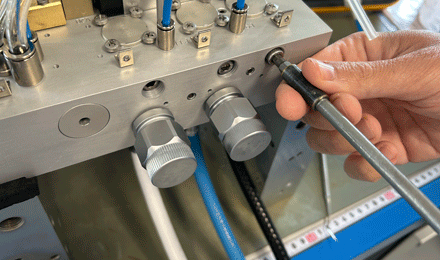
GENESIS® anaesthesia unit assembly – Source: HERSILL, S.L.
It is precisely for this reason that the integration of new technologies into the healthcare system requires a constant balance to be struck between innovation, regulation and safety. For Hersill’s Head of R&;D, one of the main challenges is to strengthen the involvement of all stakeholders in the drafting of the technical standards that regulate the development of medical devices. “I believe that the Spanish healthcare system is very similar to that of many other advanced countries. The participation of doctors in standardisation committees, both national and international, at least as far as I am aware, is minimal; they should be more aware of how much technical regulation affects their work. Ours is an increasingly well-regulated industrial sector; each type of device has specific standards that are reviewed every five years; any new therapy or application must be taken into account; it is the responsibility of all parties to get this right so that it can reach patients without errors and as soon as possible,” he explains.
Alongside the regulatory framework, Carlos Martinez identifies another key factor in boosting the country’s technological capacity:collaboration between industry, hospitals and universities.In his view, strengthening these partnerships would help to create a more robust and competitive innovation ecosystem.
The sector’s business landscape consists mainly of small and medium-sized enterprises: 93 % of medical technology manufacturers in Spain are SMEs, a structure that highlights the significance of specialised companies with a high technological component within the national industry.
In this context, he points out: “With regard to collaboration with public institutions – such as universities and hospitals – the question is why we are so different from other countries where such collaborations have led to major technological advances in our sector. For our part, we invest a great deal of time in trying to convince institutions of the need to create synergies that will strengthen the domestic industry; so far, we have not achieved much, but we will continue to work on it.”
These companies’ commitment to innovation also translates into anannual investment of 344 million euros in R&D&I, aimed at developing new solutions and strengthening the competitiveness of the Spanish healthcare technology industry.
The sector’s capacity for innovation is also reflected in its efforts to protect intellectual property: healthcare technology manufacturers registered 163 patents in 2024, 14 per cent more than the previous year,which demonstrates the dynamism of research and technological development in this industry.
But for Carlos Martinez Jordan, innovation cannot be understood solely in terms of research or collaboration between the various stakeholders in the sector. His vision positions engineering as the element that transforms knowledge into solutions capable of meeting the real needs of clinical practice. In this regard, he states: “Rather than R&D, I prefer to talk about engineering; engineering combines science and technology. Technology in our sector was initially driven by doctors, but this has evolved into a collaboration amongst professionals; in our specialisms, for example, a ventilator is very similar, in terms of components and engineering, to embedded systems in other industries.”
A development which, he explains, has made a decisive contribution to improving the health of the population. “Quality of life and life expectancy have increased thanks to many factors; I don’t believe that technology is the most important one – scientific, social and agricultural advances, as well as diet, are key – but medicine and the technology at our disposal are having a huge impact, as we are now seeing treatments and techniques that until recently seemed like science fiction,” he points out.
Innovating to remain a leader in medical technology
The development of new medical devices requires a combination of experience, technical expertise and a long-term vision. At Hersill, this commitment takes the form of ongoing work focused on the design and manufacture of equipment that meets the needs of healthcare professionals and contributes to the advancement of healthcare technology.
Although the nature of the projects means that the R&D department cannot disclose the developments it is currently working on, Carlos Martinez explains the philosophy that guides its work and how this aligns with the company’s strategic vision. “Without disclosing confidential information, our aim as the R&D department is to work towards the company’s vision, namely: ‘To be a global leader in the design and manufacture of technically unique medical devices that exceed the expectations of healthcare professionals’.”
“It’s very ambitious,” says Carlos, “but achievable if we focus on the areas in which we specialise. I believe we have a great deal to contribute in the field of mechanical ventilation; our Vitae® 40 ventilator is
already an example of a device designed to fulfil that vision, and in the coming years we aim to bring even more significant devices to market.”
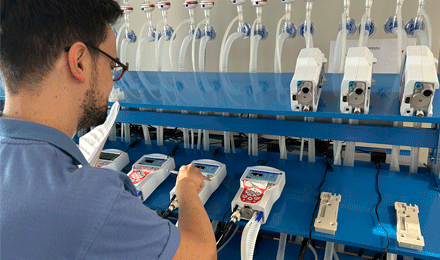
A HERSILL technician carrying out tests on the VITAE® 40 transport and emergency ventilator – Source: HERSILL, S.L.
The commitment to innovation also involves incorporating technologies capable of transforming the way medical devices are designed and developed. In this context, artificial intelligence It is emerging as a tool with enormous potential for the sector. For Martinez Jordan, its impact goes far beyond the features that medical equipment itself may incorporate. “AI has an impact at every level in our sector; we shouldn’t just think about the capabilities built into the devices – it is also changing the way medicine is practised and, of course, the way engineering is carried out,” he points out.
The innovation ecosystem is also undergoing a profound transformation thanks to the emergence of start-ups specialising in medical technology. According to Carlos Martínez Jordán, these companies will play an increasingly important role.
“Their role is unstoppable,” explains Carlos, “in every country.” They are channelling the initiatives of many professionals in the sector; many of these ideas would never see the light of day, as they do not feature among the priorities of large companies, or would only do so many years later. “I think multinationals are aware that they can no longer control major innovations. But I suppose the outcome will be similar: although the path taken is different, their products will usually end up with strong companies capable of coping with the enormous investment in promotion that our sector requires,” he says.
A future that inspires optimism
The medical technology sector is currently experiencing a period of great opportunity to continue driving innovation and strengthening the country’s industrial capacity. For Carlos Martínez Jordán, the future offers grounds for optimism. This confidence is based both on the ability of established companies to continue innovating and on the impetus that new business initiatives bring to the industry as a whole. “I believe that established companies must keep a close eye on start-ups, as they will drive many advances in medical science, but we will also continue to move forward in the traditional way; we have the advantage of experience in all fields, from development to the market, including regulatory matters.”
That optimism also extends to the future of the domestic industry, which, as Martinez Jordan explains, now has an opportunity to strengthen its technological capabilities and its strategic position.
Spain has increased its investment in research and development, although this still stands at 1.50 % of GDP, compared with the European Union average of 2.2 %– a difference that highlights the scope for boosting investment and the country’s technological competitiveness.
“As I have said, I view the future of the sector in Spain with optimism, given its starting point and also because, in the wake of the Covid-19 pandemic, more people and organisations have become aware of the importance of strengthening national capacity in medical technology.”
At Hersill, this vision translates into a sustained commitment to engineering, innovation and the development of healthcare technology designed and manufactured in Spain.This approach to progress has been a constant feature of the company for more than five decades and continues to guide its commitment to designing solutions capable of meeting the needs of healthcare professionals and helping to improve patient care worldwide.
Would you like to find out more about our solutions for ventilation, anaesthesia and emergencies? We invite you to browse our product catalogue or contact our team for further information about our technologies and projects.
Frequently Asked Questions (FAQs)
What role does engineering play in the development of medical technology?
Engineering enables the integration of science and technology to develop medical devices that meet the needs of healthcare professionals, whilst always complying with the sector’s specific safety and regulatory requirements.
What are the main challenges facing medical technology in Spain?
Key challenges include regulation, collaboration between industry, hospitals and universities, international competition and the need to continue boosting national technological capacity.
How will artificial intelligence influence medical technology?
According to Carlos Martinez Jordan, artificial intelligence will transform both the capabilities of medical devices and the way in which medicine is practised and engineering applied to the healthcare sector is developed.
Healthcare technology in Spain: let’s boost manufacturing and innovation